
On Pluralistic Ignorance
You're not alone.

Hello beloved humans,
For the last few weeks, the only television show I’ve been able to tolerate watching is All Creatures Great and Small, based upon the author James Herriot’s memoirs of his life as a veterinarian in a small Yorkshire village.
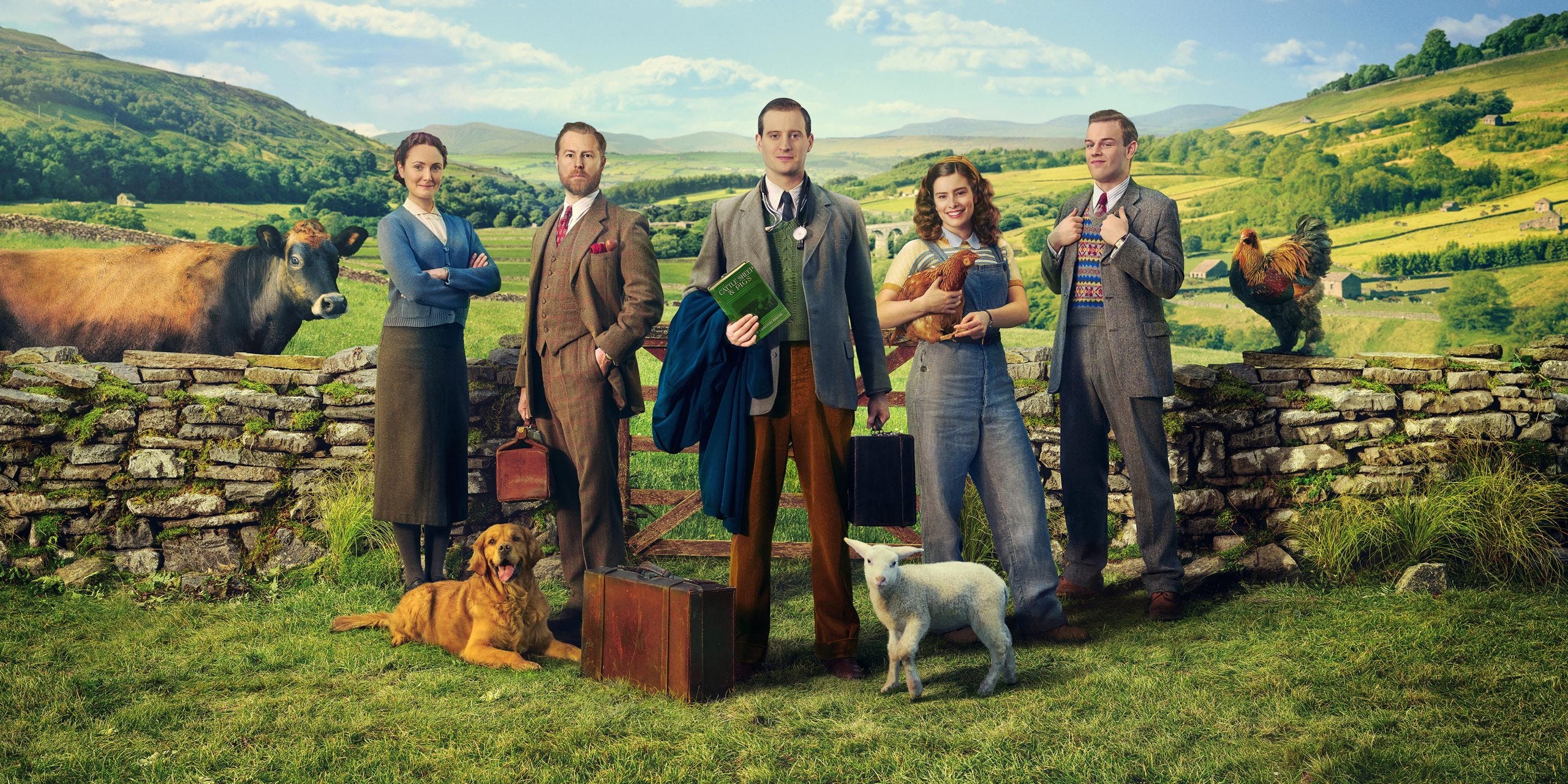
What I appreciate so much about it is that every character is human, both in the sense of having flaws and struggling but also in that of reaching for love, more love. Contrary to popular Old Happy opinion—that people are worthy when they are perfect, and not a minute before—this show gently embodies the dialectic that we are always enough as we are, and we can always try to cultivate greater virtue within us. None of the characters are perfect: they all mess up, constantly! in different ways, whether by misdiagnosing a cow’s illness or failing to be there for a friend. (There are a lot of exceptional cows in this show.) And yet they also listen when those mistakes are pointed out, and then try to make amends for them.
Watching it, you see that care is what matters most here, in this fictional world: for the animals, for each other, and for the broader village. It strikes me as one of the best examples of care ethics, embodying the ideas of Carol Gilligan and Joan Tronto and others, who argued that ethical behavior is the result of establishing mutual relationships that are centered around love. And what a comfort it is to see that enacted, even in an imagined form; and what an inspiration, a call to action for how we might bring that into our own very real homes and towns.
When care is placed in the center of a place, it disrupts all of its existing norms, turning what might feel impossible in an Old Happy context into something that is, if not effortless, then at least far, far easier. We don’t have to stress about defining some exact or structured plan; we just need to commit to holding care there, in the center, no matter who or what challenges it, and then let it guide the next action that we take.
I felt care in the center for a few weeks there as, amidst the evils wrought in Minneapolis, so many people began to take the next loving action, whether it was through calling their representatives, donating to fundraisers, or calling out its evils publicly. (Or gathering love notes for activists, as Garrett Bucks did!) Change became to feel possible solely because we saw so many brave people working to make it possible.
This reminded me of one of the most important concepts I’ve ever come across, that of pluralistic ignorance. This is the phenomenon where everyone hides their true beliefs about something in public, worried that they have the wrong ones and that they will be harmed or judged for them. Keeping quiet, we look around at everyone else, all of whom are also keeping their true beliefs to themselves, and come to the conclusion that we do indeed have it wrong.
Consider the example of climate change. This is an issue that the general public clearly feels so incredibly helpless about that most have given up talking about it, encouraging individual climate action, or even bother paying attention to new catastrophic milestones (that this has been met with a collective shrug makes me want to sob.)
I suspect it would be different if we knew the facts:
80% of Americans support major climate change policies, but believe that only around 40% of other people support them. Even more staggering: 70% of global citizens would give up 1% of their income to help halt climate change, but believe that only 30% of people do. We would know we weren’t alone in our concern; that would make us hopeful; that would drive us to action; that might change everything.
The downstream implications of pluralistic ignorance are tremendous: not only do people suffering go unhelped and big problems go unaddressed, but we miss out on valuable chances to practice moral courage, to build relationships, and to make a difference in the world.
And zooming out to look at the bigger picture, we can see the shape of our present disaster quite clearly. When we undervalue how caring other people’s opinions are, we then discount or diminish our own, and that then inspires other people to be less caring in response, and suddenly, we’re in a race to the bottom, rushing to be the one who cares less; when what we need is an collective swarm upward, like a flock of birds rising into the sky, all of us using each other’s air currents to fly higher and higher—aiming for the center of it all, for care.
I hear so often, from many of you, about how helpless you feel. I’m just one person—what can I do? Here is one answer: use your voice. If you speak up, and assert a stance, or describe what you think needs to change, it shows other people that it’s safe to do so as well—that their belief is not peculiar, but common, which then imbues them with courage to take action, too. One person, as it turns out, can do a great deal. At least, that’s how I would describe one person catalyzing a major transformation in a family, in a school, in a workplace, or in a community.
A few practical takeaways for us all here:
Using the math in these studies, we can come up with a helpful little cognitive corrective: take your baseline assumption of someone’s level of care, and double it.
When you speak up or share your emotions, you become the one who gives permission to others to do the same. What tremendous power you have! Remind yourself of this when things feel scary or hard.
Human beings are so afraid of being embarrassed in our groups that we will silence our own moral beliefs. Thus: assume that people are scared, not malicious.
Believing that you are the only one who cares about something is one of the quickest ways to abandon that care. Find people, however you can—in real life or online or in books—who see things as you do, and surround yourself with them. (A quick story: Leo Tolstoy spent nearly two decades cataloging the wisdom of hundreds of writers, spiritual teachers, and philosophers, putting them all in one guide to be his moral companion. In its introduction, he writes: “I hope that the readers of this book may experience the same benevolent and elevating feeling which I have experienced when I was working on its creation, and which I experience again and again, when I reread it every day.” If Tolstoy needed this type of support, let’s not beat ourselves up for yearning for it, too. And look at that: another case of pluralistic ignorance—that everyone’s okay on their own—solved!)
All creatures great and small deserve happiness; let us work towards that goal and remember that this pursuit brings us happiness, too.
What I’m Feeling
Mad and grateful; trying very diligently to channel the former into creative energy, which when successful, results in the latter.
What I’m Reading
I haven’t had much time to read for pleasure lately, as every spare minute has been devoted to reading hundreds of articles and stacks of books as research for my next book, which I’m so excited to be officially working on, and will share more about later. These have covered the most delightfully diverse range of topics (a preview: psychological assessments of various war criminals, the destruction of the monarch butterfly’s habitat, Paradise Lost, the impact of video games upon culture… it will all make sense soon!)
However, I have found time to squeeze in a few other reads that I am excited to recommend to you! (I keep thinking it might be fun to do a book club with a selection each month to read as a group—would anyone be interested?)
Motherland by Julia Ioffe: I stayed up far too late the other night finishing this extraordinary feminist and personal history of Russia, which I found to be so moving; I’m still thinking about it.
Bonded by Evolution by Paul Eastwick: Happy almost-Valentine’s Day, a perfect moment to interrogate everything you’ve picked up about love from the Internet, guided by a true expert in this marvelous read.
Angel Down by Daniel Kraus: What an achievement this book is, not only in its style and execution, but also in the way it lands its message about humanity. I kept finding myself saying, Wow, wow, wow as I read—or more accurately, gulped the book down.
What I’m Thinking About
Collaborators, and how they launder the reputations of harm-doers, facilitate their actions, and thus, enable atrocity. Further reading: Complicit by Max Bazerman
D.H. Lawrence’s poem Self-Pity, and this line in particular: “I never saw a wild thing sorry for itself.”
This quote, from Harold Clurman, which sums up New Happy perfectly: “We must help one another find our common ground; we must build our house on it, arrange it as a dwelling place for the whole family of scent humanity. For life, though it be individual to the end, cannot be lived except in terms of people together, sure and strong in their togetherness.”
William H. Foege’s devotion to a cause; an inspiration
Your Turn: How are you doing?
How are you feeling? What are you thinking about? How can I help you? Let me know in the comments. You are not alone. We will get through this together.